Our Plans with Ngahue IV
 For as long as I have had Hallberg-Rassy sailing boats called Ngahue (the numbers one to four), I have dreamed of sailing to
New Zealand. As a result, each Ngahue - from the first humble HR29 to HR37 to HR43 to the massive HR53 - was, within the
physical limits of each craft, prepared for long-distance ocean sailing. Way back in the late 1950s, my mother bought the
second edition of John Wray's book "South-Sea Vagabonds" for my father (she was trying to interest him in
nautical matters again, my father having served in the Dutch navy just after the Second World War; though that experience seemed
to have removed in him all further interest in nautical matters). Since my very early teens, I must have read this book nearly a
hundred times. The name given by Johnny Wray to his boat, the Ngataki (abode of the gods) was an inspiration for me to search a
Maori name starting with "Ng" for my own boat. That search, conducted at the New Zealand Embassy in Brussels
(they had a Maori dictionary, kept very handily in their reception area) came up with "Ngahue" (see the Presenting Ngahue IV
page for more details on this name). Clearly, it was also Johnny Wray's book that set me off on a nautical path that I've been
following steadily since 1989.
For as long as I have had Hallberg-Rassy sailing boats called Ngahue (the numbers one to four), I have dreamed of sailing to
New Zealand. As a result, each Ngahue - from the first humble HR29 to HR37 to HR43 to the massive HR53 - was, within the
physical limits of each craft, prepared for long-distance ocean sailing. Way back in the late 1950s, my mother bought the
second edition of John Wray's book "South-Sea Vagabonds" for my father (she was trying to interest him in
nautical matters again, my father having served in the Dutch navy just after the Second World War; though that experience seemed
to have removed in him all further interest in nautical matters). Since my very early teens, I must have read this book nearly a
hundred times. The name given by Johnny Wray to his boat, the Ngataki (abode of the gods) was an inspiration for me to search a
Maori name starting with "Ng" for my own boat. That search, conducted at the New Zealand Embassy in Brussels
(they had a Maori dictionary, kept very handily in their reception area) came up with "Ngahue" (see the Presenting Ngahue IV
page for more details on this name). Clearly, it was also Johnny Wray's book that set me off on a nautical path that I've been
following steadily since 1989.
Starting in earnest in 2013 with the purchase of Ngahue III, an HR43, firm dates were set to retire and go blue-water
sailing by the end of 2017. Ngahue III had participated in a World ARC and was perfectly equipped to go around again - all
we had to do was just modernise her a little. Nevertheless, in 2015 we seriously thought about the need of going up a size or two
for a number of reasons.
The first was that there were going to be two of us participating in this (mad?) plan - Laura and myself, and that I wanted a very
stable and larger platform that was able to hold the kind of gear that two people take with them on a circumnavigation-in-comfort these
days. And we both wanted a boat that was as 'seakindly' as possible in her movements, as one of us has a more tender stomach than the
other... Whilst the HR43 certainly was a stable platform, by the time we put our (electric) bikes, sail wardrobe and other things on
board, we'd used up a lot of the space available - she also had a tendency to move around a little more than I wished for (also for the
comfort of Laura) in rougher seas.
Yet another reason to go up a size was that we became truly committed to long-term cruising and to living aboard full-time. Jeremy
Mason of Transworld Yachts, the U.K. Hallberg-Rassy dealer, had in fact pointed this
out to me at some point when preparing my HR37 for ocean sailing: live-aboards do indeed need a lot more space. It was a wise piece of
advice, even if lost on me at the time. Fortunately, I remembered it well when looking for a bigger boat... We now needed to see
our boat as our new house and home (Jeremy's advice), and we felt that extra space was needed on board to have those things with you
that keep you busy and happy when you are a long way away from home and land.
Moving up one size in Hallberg-Rassy's range at the time took us to the HR48 (or its predecessor the HR46, which we kind of
overlooked at the time). The HR 48 then (in 2015/16) was a relatively modern design and therefore commanded a premium price, even
second hand. As a result, we saw from our calculations that we would be paying a lot of money for only 5 extra feet in boat length.
We thought about this quite a lot and decided that the Hallberg-Rassy 53 therefore seemed an altogether better choice. The design
is older, and in our eyes also more elegant. Because of this older design, the economic outlay needed to acquire a Hallberg-Rassy 53
was considerably less than what was required for e.g. an HR48. Then again, buying parts for this bigger and heavier boat costs more as
well!! Nevertheless, for a smaller initial investment you do get 10 extra feet (and double the weight)!! She also has tons of storage
space!!! Of course an older boat also needs extra care, (lots of extra care actually, as we have found since) money and attention to
ring and keep her up to date. But on balance, it seemed like a no-brainer to go for the 53. I had looked also at the Hallberg-Rassy
49, a truly ocean-going "four-wheel drive" kind of yacht - as an alternative. But the number of HR49s available when we were looking
for the next boat was absolutely zilch. With a D/L of 268 (by my calculations - others only come to 264!), the HR53
is a border-line case of being either a moderately heavy, or a heavily moderate displacement vessel... I prefer to refer to her as
moderately heavy. But however you look at her, she's a solid piece of kit, as they say.
During the summer of 2015 we started looking around in earnest for a suitable Hallberg-Rassy 53. For good measure we also
checked out a few HR48s, and kept our eyes open for any HR49 hanging around (just in case). Much as we find each and every
Hallberg-Rassy an incredibly beautiful boat, after seeing a couple of Hallberg-Rassies 53, we were clearly in love with the design
and felt that the HR53, the Queen at that Time (as HR describes her in their Story about HR book, definitely was "our" kind
of boat.
In July 2015, we had a really beautiful HR53 in our sights called Seaquest, put up for sale by Nova Yachting
of Bruinisse in The Netherlands. We spent several weekends looking her over and discussing whether we should or shouldn't go for her. Alas,
when we finally made up our minds, we were told by Nova, the Dutch Hallberg-Rassy dealer, that she had been sold to a lucky couple of Dutch
people just 20 hours before we had communicated our decision to buy Seaquest. We were absolutely shattered and utterly devastated (see mouse)!
We were a bit non-plussed though to see Seaquest (in the meantime she had been given another name) was put up for sale again towards the end of
2018! And again around 2020 and again in 2022! In July 2019 we by chance saw the former owner of Seaquest who was admiring our boat in Bruinisse...
a small world; he was thinking of buying another boat for long distance sailing (he bought a friend's HR48)! Seaquest has been sold and resold
again since. She would have been better under our management; but as it is not the boat that decides on the owner...

Flash back to summer 2015: we bravely accepted the sale of Seaquest and saw that some solid organising was required. We put Ngahue III
up for sale so that we would have money readily available when we found our ideal HR53, and started travelling around Europe to view all
available HR53s (plus a couple of HR48s)! It was all quite exciting, even if heavy on our carbon footprint... After 3 months, we finally
managed to find another suitable HR53... She turned out to be a 1995 HR53 with hull number 19, lying in one of the heated factory halls
of the Knierim Yachtbuilding company in Kiel (where they custom-build super German quality racing yachts - our 53 looked pathetically small in
their boat hall, stored next to a couple of 85 and 95-foot Knierim yachts!!). Having spent most of her sailing life in the Baltic,
"Tabaluga" (for this was her name) was solid and well-kept, even if pretty "bare" from a blue-water sailing point of view. Unfortunately,
the previous owners had merrily sanded down her decks to get beautiful brown wood - this had reduced the walking deck to significantly
less than 10mm instead of the normal 12mm (see special page on teak decks). By comparison, over the first 5 years of ownership and
multiple ocean crossings and sailing in the tropics, we've lost less than 1mm of teak deck. Such a pity of the lost wood!!! At some
time they had also painted a lot of the wood on and around the decks in some kind of brown varnish, which was now peeling off in all
sorts of "un-useful" places, such as under grab handles - the remaining slivers of varnish really cut into our hands - even 5 years
later!! However, with the necessary investments, we felt she fit the bill and could be easily converted into a proper ocean-sailing
boat for us.
The essentials of the future Ngahue IV (hull, deck & propulsion) were sound, as confirmed by an extensive survey understaken
in two steps by Mr Uwe Baykowski of Kiel. Our immediate attention was directed towards
the boat's rigging (much of it the original standing rigging from 1995 - an absolute no-no for our insurers to allow us to go from Kiel
to Holland/Belgium without replacing the whole lot) and her electronics (some of that also original from 1995). See the Technical page-Inside
on Ngahue IV to see how we have "Furuno-ised" whole swathes of the boat's electronics and how the Reckmann company renewed our
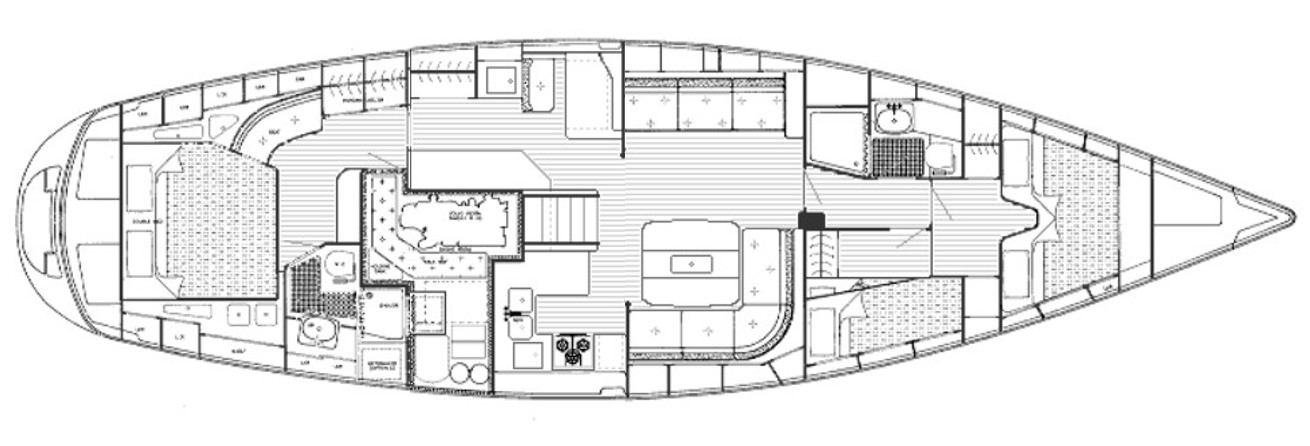
standing rigging! Pictured here is the layout of our HR53 - it also shows off the "traditional" (that is to say traditional for 1990s
designs) lines of her hull shape!
 |
In November 2017, we joined the 2017-ARC (Atlantic Rally for Cruisers) and from the Caribbean hoped to continue with a circumnavigation that
should take us, from 2018 onwards, across the Pacific, to New Zealand, and back to the Atlantic, via the Indian Ocean (2019), etc. etc. To see
how this adventure panned out, we refer you to the "We're off" pages on this site! For details on our ARC preparations, please refer to the special
"Preparing for the ARC" page... I've also included a page with lessons learned... And you'll see how we didn't manage to complete our circumnavigation
on our first attempt; or even our second attempt... But in the back of our minds the circumnavigation plans continue to brood!
When we took possession of Ngahue IV at the end of April 2016, she seemed a huge boat for just the two of us. We were completely
awe-struck by the size and weight of our new boat. Worryingly though, after a month or two she seemed perfectly manageable; and dare I say that by
the time we put her up into winter storage in September 2016 (there was a lot of work to be done), she seemed decidedly on the petite and small
side (admittedly our neighbour in Nieuwpoort, Fovea, has a modern Beneteau Oceanis 55 design and his boat, although only inches longer than ours,
appears huge when moored next to us). Taking the mast down in September 2016 was, however, a salutary experience, and a useful reminder of the size
and weight of fittings on a boat this size!
When sailing down to Lanzarote in very big seas, however, we again realised how small any sailing boat is in a big ocean! Look at the film we
posted on You-Tube, as well as our further ocean-sailing films!
Return to Homepage